Filters
Filters are defined by their own classes in PISCOLA: SingleFilter and MultiFilters.
SingleFilter
This class represents a single filter and can be called in the following way:
from piscola.filters_class import SingleFilter

filt = SingleFilter('Bessell_B')
print(filt)
name: Bessell_B, eff_wave: 4421.6 Å, response_type: photon
The name of the filter must match one of the available ones in the filters directory in PISCOLA. Each filter will contain information about its wavelength range, transmission function, etc:
filt.__dict__
{'name': 'Bessell_B',
 'filt_file': '/path/to/piscola/filters/Bessell/Bessell_B.dat',
 'wave': array([3605., 3610., 3615., 3620., 3625., 3630., 3635., 3640., 3645.,
        3650., 3655., 3660., 3665., 3670., 3675., 3680., 3685., 3690.,
        3695., 3700., 3705., 3710., 3715., 3720., 3725., 3730., 3735.,
        ...
        5540., 5545., 5550., 5555., 5560., 5565., 5570., 5575., 5580.,
        5585., 5590., 5595., 5600., 5605., 5610.]),
 'transmission': array([0.00000e+00, 1.98629e-04, 8.56342e-04, 1.51406e-03, 2.17177e-03,
        2.82948e-03, 3.48719e-03, 4.14491e-03, 4.80262e-03, 5.46033e-03,
        6.11805e-03, 7.40083e-03, 1.01283e-02, 1.28558e-02, 1.55832e-02,
        ...
        5.89171e-04, 4.85735e-04, 3.82299e-04, 2.78863e-04, 1.75427e-04,
        7.19915e-05, 0.00000e+00]),
 'response_type': 'photon',
 'eff_wave': 4421.611517501659,
 'comments': ''}
The response_type has to be either photon or energy (most have the former). If a README.txt file is found in the filter’s directory (Bessell/ in this case), it is added to the comments. For information about the available functions, check the Filters Class.
MultiFilters
This is a class that wraps the single filters into a single class:
from piscola.filters_class import MultiFilters

filters = MultiFilters()
filters.__dict__
{'bands': ['Bessell_U', 'Bessell_B', 'Bessell_V', 'Bessell_R', 'Bessell_I'],
 'Bessell_U': name: Bessell_U, eff_wave: 3575.6 Å, response_type: photon,
 'Bessell_B': name: Bessell_B, eff_wave: 4421.6 Å, response_type: photon,
 'Bessell_V': name: Bessell_V, eff_wave: 5515.1 Å, response_type: photon,
 'Bessell_R': name: Bessell_R, eff_wave: 6605.5 Å, response_type: photon,
 'Bessell_I': name: Bessell_I, eff_wave: 8071.3 Å, response_type: photon}
By default, the Bessell filters are always included as these are the ones traditionally used for cosmology (e.g. for colour \((B-V)\)). However one can also call the MultiFilters class with other filters:
bands = ['Megacam_g', 'Megacam_r', 'Megacam_i', 'Megacam_z']
filters = MultiFilters(bands)
print(filters.bands)
filters.plot_filters()
['Megacam_g', 'Megacam_r', 'Megacam_i', 'Megacam_z', 'Bessell_U', 'Bessell_B', 'Bessell_V', 'Bessell_R', 'Bessell_I']
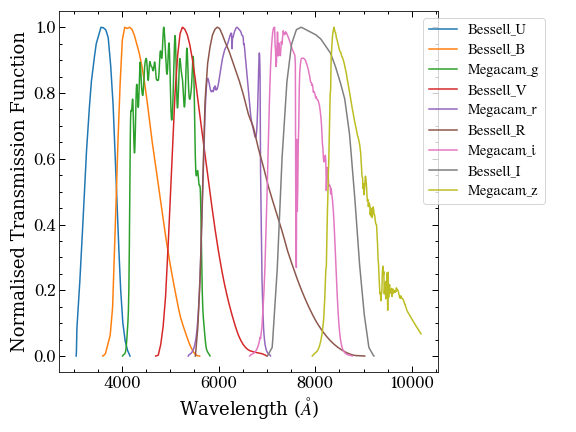
For information about the available functions, check the Filters Class.
Adding New Filter Files
To add filters which are not included in PISCOLA one must add them under the filters directory, preferably on a separate sub-directory. The filter will get the name from the file name. For example, we can create a file with the name New_g.dat. PISCOLA will then assume that the name of the filter is New_g. The .dat extension is required. The file must contain two columns: wavelength in angstroms in the first column, and tranmission in the second one.